More to Explore
Growing Guide: Ground Cherry

Grow and Save Ground Cherry Seeds
Physalis grisea, Physalis pruinosa, Physalis peruviana, fam. Solanaceae
How to Grow Ground Cherries
With different species commonly known as ground cherry, dwarf cape gooseberry, and strawberry tomato, this plant produces a small, yellow, edible berry surrounded by a papery husk. Ground cherries typically produce hundreds of fruit on each plant.
How and When to Start Indoors
Sow seeds indoors 6–8 weeks before the last frost. Plant seeds ¼ inch deep.
Time to Germination
5-8 days
When to Transplant
Plant outdoors two to four weeks after your last expected frost. Be sure to harden off seedlings before planting outdoors. Plants prefer a rich, light, warm soil in and a sunny garden bed.
Spacing Requirements
Transplanting into the garden, space plants at least 2 feet apart. Ground cherries have a sprawling growth habit similar to tomatillos. Be sure to give plants plenty of space in the garden.

Special Considerations
If you have grown ground cherries before, you may not even need to plant this crop again, as ground cherries often volunteer in the garden by self-seeding. Make sure that your soil is well fertilized, as this crop is a heavy feeder and takes a lot of nutrients from the soil.
Common Pests and Diseases
Ground cherries are not susceptible to many bacterial, fungal, or viral diseases. However, plants do occasionally suffer damage from flea beetles, whiteflies, ground cherry leaf beetles, and mites. Keep plants regularly watered and place floating row covers over them if these pests are particularly prevalent in your garden.
When and How to Harvest for Food Consumption
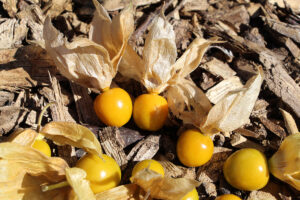
The fruits must be fully ripe to be edible. At maturity, the husks of fruits become dry and papery, and the fruits turn from green to yellow and drop from the plants. Mature fruits should be collected from the ground after they have fallen. The husk is inedible and must be removed.
Eating
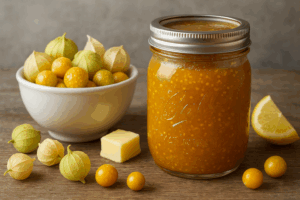
Ground cherries can be eaten fresh, processed into jam, and baked into pies. Their distinctive, sweet-tart taste lends itself to preserves, sauces, and tarts. Try Grandma Ott’s Ground Cherry Jam from Seed Savers Exchange co-founder Diane Ott Whealy.
Storing
Compared to many fleshy fruits, ripe ground cherries have a long shelf life and can be held for several weeks, for both eating and seed saving. To store ground cherries, leave the husks on and store in a cool, dry, well-ventilated place (like a mesh basket or shallow tray).
It is also easy to freeze husked, whole ground cherry fruits for later use. First remove the husk and rinse off the sticky coating. Then place the ground cherries on a baking tray in a single layer and stick the tray in the freezer. Once the ground cherries are frozen, you can transfer them to a bag or container of your choice.
How to Save Ground Cherry Seeds
Ground cherries typically produce hundreds of fruit on each plant so you need to plant only one ground cherry plant to yield viable seeds.
Life Cycle
Annual
Recommended Isolation Distance
When saving seeds from ground cherries, separate varieties by 300–1,600 feet.
Ground cherries are self-pollinating, so barriers—such as blossom bags and isolation cages—can be successfully used to isolate them from pollinators. Learn more about isolation methods.
Recommended Population Sizes
You only need to plant one ground cherry plant to harvest viable seeds. To maintain a variety over generations, save seeds from 5–20 plants.
Harvesting
Ground cherries reach seed maturity and market maturity at the same time, and can be harvested for seed at the same time as for food consumption.
Harvest ground cherries when the husks are dry and papery and the fruits have changed color from green to yellow and fallen on the ground.
An individual ground cherry fruit can contain more than 100 seeds, so many gardeners stop harvesting for seed after gathering a few fruits from each plant in the population and simply continue to harvest only for consumption.
Cleaning and Processing
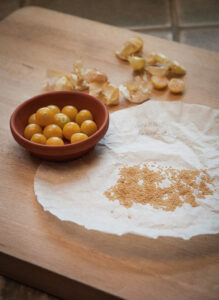
Ground cherries are wet-fruited crops and seeds must be extracted from the flesh and juicy pulp. Remove the husks before processing to simplify the process.
Dislodging the Seeds
For large batches: Ground cherry seeds can be processed by blending the fruits with ample water in a food processor with a dull blade.
For small batches: Because ground cherry fruits are soft, small batches can be efficiently hand-processed by removing husks, cutting fruits, and squeezing the pulp and seeds into a bowl. The mixture can be mashed by hand, and decanted and rinsed as described above.
Decanting the Seeds
Decanting involves pouring out a mixture of pulp, seeds, and water to “float off” the unwanted pulp and lighter, immature seeds. The dense, mature seeds will sink to the bottom.
To decant the mixture, pour the blended fruits into a larger container, add more water, and agitate the watery mash until the seeds separate from the pulp. When the seeds have settled to the bottom of the container, the pulpy water can be poured off the top, leaving only the seeds.
Keep decanting this mixture until most of the pulp and any immature seeds have been discarded.
Rinsing and Drying the Seeds
The viable seeds that remain should be transferred to a very fine strainer, rinsed under a stream of water, and placed on a screen or coffee filter to dry in a cool, well-ventilated area.
Storage and Viability
When stored under cool, dark, and dry conditions, ground cherry seeds will remain viable for 4–6 years.
Read more about storing seeds.
Ground Cherry Varieties
When you make a purchase from Seed Savers Exchange, you help fulfill our nonprofit mission to protect our food and garden heritage.
NEW for 2026: Dulce de la Tierra
P. peruviana, commonly known as Cape gooseberry, goldenberry, and Peruvian ground cherry.

New from our seed bank collection for 2026!
Translating to “Sweet of the Earth” or “Candy of the Earth,” ‘Dulce de la Tierra’ matures a little later than Physalis pruinosa ground cherries, but delivers a far more intense flavor. Yellow fruits boast a delightful tropical flavor reminiscent of just-ripe kiwi with notes of pineapple.
Eduardo Valenzuela, an Exchange lister from California, donated this variety to Seed Savers Exchange circa 2006.
Aunt Molly’s
P. pruinosa

Easy-to-grow, prolific, and super-sweet, this ground cherry works well for preserves and pies, over ice cream, and in fresh-fruit salads—or can simply be eaten straight out of the garden. This beloved variety takes its name from an ice cream stand, named not for a dear aunt, but for a cherished pet dog of the owners of Territorial Seed.