


More to Explore
Growing Guide: Carrot
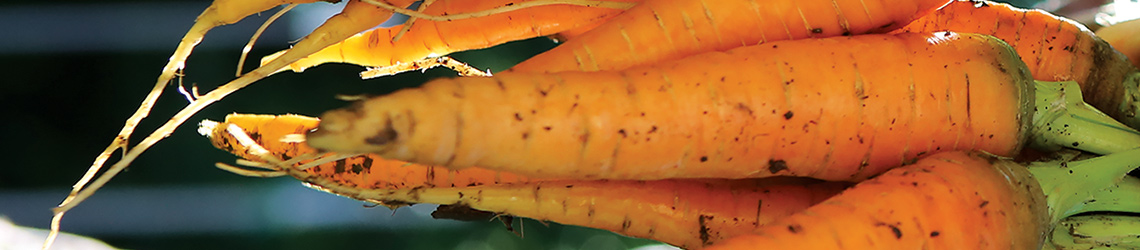
Grow and Save Carrot Seeds
Carrots (Daucus carota) are appreciated around the world as fresh eating vegetables, kitchen staples, and long-term storage crops. When planting carrots, be aware that they can be finicky in the early part of the season. Carrots are biennials, producing seed after two years of growth, but the reward is well worth the effort. Carrot seed can be used for next year’s crop and also as a culinary spice.

How to Grow Carrots
Time of Planting
Plant carrot seeds outdoors when the soil is above 45 degrees F.
Spacing Requirements
Plant carrot seeds ¼ inch deep and 1 inch apart. Later in the spring, thin carrot plants to 2-3 inches apart in rows 16-24 inches apart.
Learn more about thinning seedlings.

Time to Germination
7-21 days
Getting a good germination rate with carrots can be tricky. They can take several weeks to germinate and require consistent moisture. Take care to keep the soil moist, but not waterlogged, until the seedlings emerge. You may need to water 2-3 times a day.
At Heritage Farm, we use drip irrigation tape to help mitigate low carrot germination and weed pressure. Watch this short video to learn how:
Special Considerations
As the shoulders of the carrots begin to emerge from the soil, mound a little mulch or dirt around the exposed root to prevent greening.
Growing Carrots in Containers
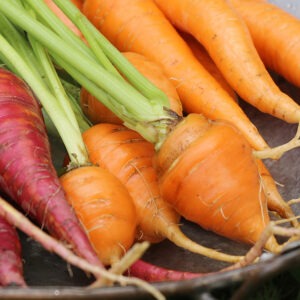
Though they prefer the ground, carrots can also grow well in containers. Make sure your container is deep, opaque, and has drainage holes. Smaller carrot varieties, such as ‘Paris Market,’ are ideal for container growing.
Learn more about container gardening.
Plant Care
After seedlings emerge, allow the top layer of soil to dry in between watering.
Weed consistently to ensure the plants have room and resources to grow without the competition of weeds. Hand hoes, collinear hoes, and small scuffle hoes are handy for precision weeding. Be sure to scratch every square inch of soil, even if you don’t see a weed, in order to catch any germinating “thread stage” weeds.

Signs of Distress
Stunted growth: Can be caused by moisture stress (too little or too much water), overcrowding, or competition from weeds.
Drooping or wilting leaves: Indicates that the plant needs more moisture.
Common Pests and Diseases
Carrot plants can suffer from a number of pests and diseases, including carrot rust fly, carrot weevil, cutworm, flea beetle, slugs, leaf blight, and soft rot. Consider planting resistant varieties and thin plans on a damp, overcast day.
Extending the Carrot Growing Season
To get the most out of the growing season, plant another round of carrots at the end of summer or beginning of fall. At Heritage Farm (growing zone 4b) we like to plant carrots in mid-August for a fall harvest. Learn how to plant a fall garden.
Carrots are a great cold-season crop and are remarkably cold tolerant. In fact, a hard frost actually make carrots sweeter in flavor! Treat the soil as a sort of refrigerator and leave carrots in the ground until you’re ready to eat them.
Harvest carrots as long as the soil cans still be worked with a fork. Carrots can tolerate temperatures down to around 20°F and, with heavy mulch, can stay in the ground well after the first hard freezes. Tools such as floating row cover and cold frames can help to extend the growing season even further.

Learn more about extending the growing season.
When and How to Harvest for Food Consumption

Harvest carrots once the shoulders are poking out of the soil and the root is wide. To harvest carrots, pull the roots up by the carrot shoulders shoulders or base of the leaves to prevent breakage.
You may also use a pitchfork to release the carrots from the soil before lifting them out with your hands.
Be gentle when uprooting carrots; some deep rooted varieties may snap when harvested.
Eating
Carrots are a versatile culinary crop. They can be used fresh, in salads, diced and simmered with onions and garlic to start many sauces, or they can be roasted and served as a main dish. The texture of carrots holds up to many cooking methods, from stews to pureed soups.
All parts of the carrot plant are edible! Carrot greens are also edible and make a wonderful pesto. Carrot seeds are sometimes used as a culinary spice.
For a twist, check out this delicious Orange Creamsicle Smoothie recipe, which packs in one cup of shredded carrots!
Storing Carrots

Short-term storage
Unpeeled (preferred): Store whole, unpeeled carrots and store in a sealed plastic bag in the crisper drawer of your refrigerator. Cutting the greens off will help conserve moisture. Brush off most of the soil, but avoid washing the carrots, as excess moisture can lead to faster rot. Unpeeled carrots can last up to a month in the refrigerator.
Peeled: Carrots will keep longer unpeeled, as peeling carrots will cause them to dry out faster. To store peeled or cut carrots, wrap loosely in a damp paper towel, then place in a sealed plastic bag in the crisper drawer of your refrigerator. Peeled or cut carrots have a shorter shelf life than whole carrots.
Long-term storage
Frozen: With proper preparation, carrots can be frozen. First, wash and peel the carrots and slice into rounds. Blanch the carrots and pat dry. Freeze the carrot slices in a single layer on a baking sheet before transferring to a plastic freezer bag.
Fresh: Fresh carrots can last all winter long with proper storage. First, brush off most, but not all, of the soil from the carrot. Leave some soil on the carrot to help protect the carrots from disease and rot in storage. Do not wash the carrot as washing removes the carrots natural protective barrier.
Cut the greens off the carrots, making sure not to damage the grow point. Carrot roots can be stored in perforated plastic bags or any ventilated container. In bags, evenly disperse wood shavings around the carrot roots.
In containers, line the bottom of the container with slightly damp wood shavings, damp sand, or dry leaves. Alternate single layers of carrots with more layers of storage medium. Take care to make sure the carrots are not touching one another.

Carrots will last the longest when stored in a cool dark place, around 35 degrees F with a relative humidity of 90-95%.
How to Save Carrot Seeds

Life Cycle
Carrots are a biennial crop and take two seasons of growth to produce seeds. In between growing seasons, carrots require vernalization, a period of prolonged exposure to cool temperatures.
Recommended Isolation Distance
Carrots are insect pollinated. To produce true-to-type seeds, separate different carrot varieties by at least 800 feet-½ mile in their second season of growth.
TIP: Carrots will cross with wild carrot, also known as Queen Anne’s Lace. Wild carrot umbels look very similar to carrot umbels and plants are often found in meadows, ditches, and along roadsides. Carrot and wild carrot are both the same species (Daucus carota) and when crossed will produce viable hybrid seed that is not true-to-type. For this reason, using isolation cages is a good idea when saving true-to-type carrot seeds.
Since carrots are pollinated by insects, using isolation cages requires the introduction of pollinators.

Recommended Population Sizes
To ensure viable seeds, save seeds from at least 5 plants. When maintaining a variety over many generations, save seeds from 20-50 plants. If you’re saving seeds for genetic preservation of a rare variety, save seeds from 80 plants.
Vernalization
In between growing seasons, carrots require vernalization, a period of prolonged exposure to cool temperatures. Vernalization can happen in the field or in storage.
Overwintering Carrots in the Ground
You can leave carrots in the ground over the winter if you will have 10-12 weeks of cool weather (around 50 degrees F) without regular temperatures below 15 degrees F.
You may still want to dig up the carrots in order to cull the undesirable plants. Remove the carrots that are forked, diseased, have stunted growth, or don’t meet the variety description. Don’t forget to taste one to make sure it’s a variety you like!

In their second year of growth, carrots need more space than they do in their first year. Plant carrots 6-18 inches apart in rows 24-48 inches apart.
Overwintering Carrots in Storage
In cold climates, where winter temperatures frequently fall below 15 degrees F, carrots must be dug before the ground freezes and vernalized in storage.
Preparation
- If possible, dig carrots when the soil is relatively dry. Carefully use a pitchfork to loosen the carrot from the soil, then lift them out of the ground. Grab by the shoulders or base of the leaves to prevent breakage.

Use a pitchfork to help pop the carrots out of the soil - Shake or gently brush the roots to remove as much soil as possible, but do not wash them. Leaving some soil on the carrots helps to protect them from rot and disease in storage.
- Trim tops down to just above the crown by making two or three diagonal cuts upward from the base of the leaf stems, being careful not to cut the crown of the plant.

Trim the leaves of the carrots before putting them into long-term storage - If the carrot is longer than five inches long, cut the root so that the carrot is only 3-5 inches long. The part of the carrot longer than 5 inches is the tissue that is most susceptible to rot in storage. Some rotting in storage is okay, but excessive rotting in storage will infect and destroy the apical bud needed for next year’s shoot growth.

Trim the carrots to be 3-5 inches in length to help avoid rot.
Culling Off-Types
Be sure to remove any diseased, forked, stunted, or off-type roots prior to storage and again before replanting.
Storage
Store first-year biennial carrots in the same way as carrots in long-term storage for food consumption—in perforated plastic bags or any ventilated container. In bags, evenly disperse wood shavings around the carrot roots.

In containers, line the bottom of the container with slightly damp wood shavings, damp sand, or dry leaves. Alternate single layers of carrots with more layers of storage medium. Take care to make sure the carrots are not touching one another.
Store the carrot roots in a cool dark place (such as a root cellar) at about 35 degrees F. Make sure the carrots get at least 10 weeks of this vernalization period.
Instructional Video
Watch this video learn how to harvest, prepare, and store first-year biennial carrots.
Planting Out
In the spring, roots should be removed from storage and prepared for replanting. When growing carrots for seed, increase spacing to 6-18 inches between plants, in rows 24-48 inches apart.
Transplant each carrot so that the crown is just above the soil line, mimicking the height of the crown during its first season in the garden.
As second-year carrots grow, plants will produce tall flower stalks. Staking is recommended.

Assessing Seed Maturity
Carrot flowers will form an umbel, or flower head, that will produce seeds. As carrot seeds mature, the umbel turns from green to tannish brown and crispy. Fully mature seeds detach easily from the plant.


Harvesting
Individual seed heads can be harvested by cutting stems several inches below the umbels. Cut the umbels into a plastic bin to avoid losing seeds. Seeds should appear to be brown; green seeds are not mature enough to harvest.
Allow the umbels to dry after harvesting. Move the harvested material to a well-ventilated space that is protected from rain for 5-14 days. Storing the umbels on screens helps to allow adequate airflow. Let the plants dry in a cool dry place, away from the reach of rodents.
Cleaning and Processing
Carrots are a dry-fruited crop, and are cleaned using dry processing methods. Learn more about dry seed processing.
Threshing
Threshing is the process through which seeds are loosened from the rest of the plant material. Carrot seeds can be easily threshed by rubbing the seed heads between one’s hands or against a fine mesh screen.
Alternatively, dislodge the seeds into a container by gently brushing the tops of the seed heads. This method will result in cleaner seed that contains fewer dry flower stems.
For large quantities of seed, you may lightly tread on the umbels with clean, dry shoes.
Winnowing
Winnowing is the process through which excess plant material (chaff) are removed from the seed supply using an airstream.
After threshing, slowly drop the seeds and plant material in front of a box fan. The airstream will blow the lighter chaff and immature seeds away from the heavier mature seeds.

You may also create an airstream with your breath. Place the seeds and chaff mixture in a bowl and blow a soft and steady stream of air over the bowl.

Instructional Video – Saving Carrot Seeds
Watch this video to learn how to save seeds. Produced as part of The Seed Garden book.
Storage and Viability
Store carrot seeds in a cool, dark, and dry place in an airtight container to keep out moisture and humidity. When stored under these conditions, carrot seeds can be expected to remain viable for up to 6 years.
Sharing Carrot Seeds
Wonderful work—you’ve saved seeds from your favorite carrot varieties! Consider sharing your carrot seeds—and the joy they bring—with friends, neighbors, and fellow growers through the Exchange, Seed Saver Exchange’s gardener-to-gardener seed swap.
Our Carrot Favorites
‘Red-Cored Chantenay’

This popular variety has sweet orange flesh, wide shoulders, thick, edible roots, and a red-orange core that gives the variety its name. Easy to grow—prepare and enrich the soil with nutrients, and a prolific harvest will result. The 6″ roots are great for soups, canning, or fresh eating. Introduced by C.C. Morse & Company in 1929.
‘Dragon’

This carrot’s beautiful red-purple exterior provides a striking contrast to its yellow-orange interior and light yellow core. A treat for the eye when sliced, its sweet, almost spicy, flavor makes this carrot a home gardener’s favorite and a best-seller at specialty and farmers’ markets. Considered the most refined purple carrot available, it was bred by Seed Savers Exchange member John Navazio.
‘Danvers’

This carrot was developed in the late 1800s in the town for which is it named: Danvers, Massachusetts. A leading variety for home and market gardeners alike, this variety stores well and produces high yields even in clay and heavy soils. Its bright-orange flesh is nearly coreless, sweet, and tender. The uniform roots grow up to 8″ long.
‘Rainbow Carrot Mix’

If you love carrots, this is the mix for you! It contains four wonderfully distinct varieties: ‘St. Valery’s’ (red-orange, sweet, and excellent for storage); ‘Cosmic Purple’ (purple outside, orange inside, and sweet); ‘Solar Yellow’ (sunshine-yellow, sweet, and juicy); and ‘Lunar White’ (creamy-white, sweet, and productive). All four varieties will delight your palate (and your eyes!) while dressing up your salads, soups, and sides. 70-75 days.
‘Paris Market’
Nineteenth-century French variety. Early round red-orange carrots, 1-2″ in diameter, uniform and very sweet. Does well in shallow or rocky soil. It can also be grown in containers. Highly sought after by gourmet restaurants and a great seller at markets.