Keep Exploring!
When you make a purchase from Seed Savers Exchange, you help fulfill our nonprofit mission to protect our food and garden heritage. Do even more good by making a donation to help us preserve and share even more heirloom varieties!
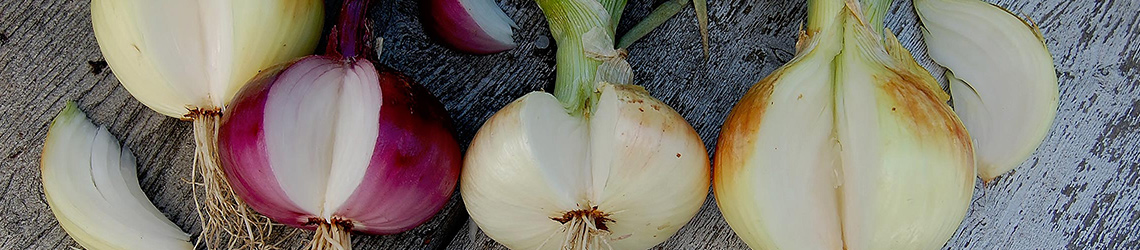
A culinary staple, onions are an essential vegetable in American gardens. Onions, like other members of the Allium family, are biennials, producing seeds in their second year of growth.
Allium cepa
When we think of an onion, the common onion (bulb-forming) comes top of mind. Common onions may have white, yellow, brown, red, or purple skin. They can be categorized as sweet, mild, or pungent. Bulbs vary from round globes to slightly flattened or elongated shapes. They can also be categorized into short-, intermediate-, or long-day types, depending on the length of day necessary to produce bulbs.
Red Onions

Red onions are characterized by their bold red or purple skins and very pungent flavor. Red onion is a popular addition to salads, salsas, and garnishes, and is also commonly pickled.
Varieties include:
‘Long Red Florence’ is a mild red onion with an oblong shape, great for cutting. This Italian heirloom originated in the Tuscany region of Italy.
Yellow Onions

Yellow onions are characterized by their yellow-to-brown papery skin, and are great for long-term storage. Yellow onions have a balanced, mild flavor (not too sharp, but not too sweet) that makes them the most versatile onion in the kitchen. Spanish types are slightly larger and sweeter. Yellow onions also make the best caramelized onions.
Varieties include:
Sweet Onions

Like their name, sweet onions are sweeter than other varieties and may have white or tan skin. These onions make wonderful onion rings and are great in soups where onion is a main ingredient, like French onion soup. However, sweet onions generally don’t store as well as other types. For long-term storage, you might consider slicing and freezing them.
Varieties include:
White Onions
White onions are strong, but less pungent than red onions. They are slightly sweet and deliciously crispy when raw. These onions are commonly used in Latin American cuisines, especially Mexican.
Allium fistulosum, Allium cepa

Also known as scallions or green onions, these onions have a small bulb with long, tube-shaped green leaves. Most recipes call for the leaf part of the onion to be used as a garnish or seasoning, similar to an herb, but the small bulb is also edible. These onions do not store well and should be used soon after harvesting, though you may grow bunching onions as a “cut-and-come-again” green by harvesting leaf cuttings a little at a time.
Varieties include:
Allium cepa var. aggregatum

Shallots are smaller than common onions and are more elongated in shape. They typically have reddish-brown skin and in the bulb are one or two large cloves, akin to garlic. They are sweeter than common onions but also pungent with a slight garlic flavor. Learn how to grow and save shallot seeds.
Varieties include:
Common onions typically have a very long growing season, and we recommend starting onion seeds indoors in the early spring and planting them out as bare roots once the soil is workable, especially in Northern climates.
Many gardeners also purchase onion plants and onion sets. Onion plants are also onions that were started from seed early in the year and are sold as transplants. Onion sets were grown in the fall and harvested early as immature bulbs to be transplanted in the spring.
If you are purchasing onion plants or sets this year, you can skip right to the transplanting section of this guide.
Plant onion seeds indoors 8–10 weeks before the average last frost date in your area, and plan to transplant them around 2 weeks before your last frost day.
Sow seeds ¼ inch deep into small containers or open flats with sterile potting soil or seed-starting mix. Soil should be moist, but not wet. It should hold its shape when squeezed into a ball, but should not drip water.
At Heritage Farm, we like to sow onion seeds in open flats. To do this, create small, shallow trenches in your container of choice, then sprinkle onion seeds along the length of the trench. Finally, cover the trenches with a thin layer of soil. Be sure to label your seeds with the variety and date sown!


For starting small seeds, like onions, we like to use the handy RapiClip Dial Seed Sower. This tool includes a dial and spout that allow for better precision and even distribution of seeds.

Water and Humidity – After sowing the onion seeds, water them in with a hose or watering can with a low, gentle flow. Keep the soil consistently moist, but not waterlogged. Humidity domes can help to retain heat and soil moisture, but should be removed once germination occurs.
Heat – Although not necessary, onions do benefit from bottom heat during the germination process. Specialized heat mats are great for this, but so is the top of the refrigerator! Be sure to remove any bottom heat after germination occurs to prevent seedlings from growing too rapidly.
Time to Germination – Seeds will germinate in 4-10 days when started indoors.

Watch this video to learn how to start onion seeds indoors!
Ventilation – Once the seeds germinate and tiny green seedlings begin pushing their way out of the soil, keep the seedlings in a well-ventilated space—fans are great to help maintain airflow—with plenty of light.
Light – Natural sunlight from a window usually isn’t adequate, so it’s best to use supplemental lighting, such as LED grow lights or fluorescent bulbs. LED lights are great because they produce minimal heat. Set the lights a few inches above the seedlings, and adjust the height as they grow.
Watering – Water when the top layer of soil is dry and do not allow the soil to get waterlogged. Use a vessel with a low flow to avoid damaging or misplacing the delicate seedlings.

Trimming – Keep the tops trimmed to roughly 4 inches tall to prevent the seedlings from toppling over.
Gradually harden off onion transplants about 3-4 weeks before your last frost date by introducing the seedlings to direct sunlight, dry air, and cool nights.
Learn how to harden off seedlings.
Transplant outdoors about 2 weeks before the last frost date, on a cloudy day, if possible. Onion transplants should be at least the width of a pencil.
To do this, break apart your onion plants and trim the roots and tops. Roots should be trimmed to roughly 2 inches and the green tops to roughly 4 inches.
Create a small furrow in your garden, about 2 inches wide and 4 inches deep. Water this furrow before planting your seedlings to make transplanting easier. Transplant the onions into the furrow.
When transplanting your seedlings, space them at least 6 inches apart in rows 12-14 inches apart.
Onions need full sun in order to produce bulbs. Plant onions so they get at least 12-14 hours of daylight each day.
Although onions are most commonly grown as transplants, it is possible to grow onions successfully by planting seeds directly into the garden.
Onion seedlings can tolerate a light frost. Sow onion seeds outdoors as soon as you can work the soil, or 3-4 weeks before your last frost date.
Onions need a lot of water for good bulb growth, about 1 inch per week. Water deeply but infrequently, and monitor rainfall. Water at the base of the plants or use irrigation to help prevent disease.
Onion seedlings are small and do not compete well with weeds. Plant onion seedlings in the least weedy part of your garden. Add a layer of mulch, such as straw, to help suppress weeds.
Weed regularly to ensure the plants have room and resources to grow. Onions have shallow and delicate roots, so be very careful while weeding and don’t weed very deeply. Be sure to scratch every square inch of soil, even if you don’t see a weed, in order to catch any germinating “thread stage” weeds.
Hand hoes, collinear hoes, and small scuffle hoes are handy for shallow precision weeding, as is simply using your fingers to rake through the soil.

Several bacterial, fungal, and viral diseases can affect onion growth. Insect pests can also be a problem to various degrees in different parts of the United States. Plant your onions in a well-drained space.
Diseases and fungi such as Fusarium basal rot, white rot, and Botrytis neck rot can affect crops in storage. Crop rotation can help prevent these diseases.
With their shallow roots and compact size, onions are a great crop for growing in containers. When choosing a container, make sure it is deep, opaque, and has drainage holes. Use potting soil mixed with a generous amount of compost to add nutrients, increase drainage, and help retain moisture. Keep in mind, you may find you need to water onions grown in containers more frequently than ones planted directly into the soil.
Learn more about container gardening.
Onions, along with other alliums such as garlic and chives, make great companion plants for other crops. The strong aroma of onions is unappealing to deer, rodents, aphids, and other garden pests. Onions don’t take up too much space and are great for intercropping among vegetables like brassicas, leafy greens, tomatoes, peppers, eggplants, and potatoes, or creating a protective border around garden beds.
While onions are a great companion plant for many crops, there are some that should not be planted next to onions. Keep onions away from chives, garlic, asparagus, beans, peas, and sage. Onions can outcompete these crops and stunt their growth, or may affect their flavor.
Learn more about companion planting.
The tops of bulb onion plants fall over naturally once the bulbs have matured. When half of the tops in a planting have fallen over, harvest all of the bulbs. To do this, gently tug on the bulb and it should lift right out of the soil. Leave the tops on until after the onions have cured. Try to harvest on a dry, sunny day, if possible.
Cure onions for two to three weeks after harvesting by storing them in a warm, sheltered place away from direct sunlight. Lay the onions in a single layer to make sure they get good airflow. Using fans can help in the drying process.
When the onions feel paper-dry on the outside, clip off the tops and roots, and lightly brush off loose soil. You may also choose to leave the stems intact and braid them together to hang in storage.

After curing, store the onions in a cool, dry place. Arrange them in a single layer or hang them in mesh bags.
Always handle onions very carefully; the slightest bruise will encourage rot. Properly cured storage onions will store for 6–8 months in a root cellar or cool basement.
Pay attention to the variety, as some are better for long-term storage than others. For varieties that don’t store well and any bulbs that are damaged, slice the onions and freeze.

Onions have limitless potential in the kitchen and are indispensable for flavoring savory dishes. Onions can be roasted, fried, pickled, sautéed, and combined into dishes in dozens of other ways. Bunching onions, especially, are perfect for salads, pastas, and soups. Onion jam or compote is a great way to use a flush of red onions that will not store as well as white or yellow onions.

Try these onion recipes:

Although types of onions, such as multiplier onions, are grown as perennials, common onions are a biennial crop and take two seasons of growth to produce seeds. In between growing seasons, onions require vernalization, a period of prolonged exposure to cool temperatures.
When saving seeds from onions, separate varieties by at least 800 feet up to ½ mile.
Onions have perfect flowers (possessing both pollen-producing/male and pollen-receiving/female parts) that are protandrous, shedding pollen before the stigma becomes receptive. Because of this, onions rely on insects for pollination.

Since onions are biennial, it’s most practical for gardeners to save one onion variety for seed per year. Because onions don’t typically flower until their second year, gardeners can grow as many first-year onion plants without compromising the purity of the one variety being saved.
Another option is to cover onion plants with isolation cages. However, since onions are insect-pollinated you will have to introduce insects, such as flies, into the cages in order to ensure pollination.
Learn more about isolation methods.
To ensure viable seeds, save seeds from at least 5 plants. To maintain a variety over time, save seeds from between 20-50 plants.
In between growing seasons, carrots require vernalization, a period of prolonged exposure to cool temperatures. Vernalization can take place in the ground or in storage.
You can leave onions in the ground over the winter if you will experience 8-10 weeks of weather consistently below 54 degrees F, ideally between 48 and 54 degrees F. In moist soil, onions are prone to rotting when temperatures dip below this range. In drier conditions, bulbs may survive to around 20 degrees F.
If overwintering onions in the ground, be sure to cover them with a heavy layer of mulch to keep them protected and warm.
In the spring, lift up the onions in order to cull the undesirable plants. Remove any onion plants that are diseased, have stunted growth, or don’t meet the variety’s description, then replant.
In cold climates, onions are often dug in the fall and stored indoors over the winter.
Preparation – Harvest and cure the onions as you would for regular storage and food consumption.
Culling Off-Types – Be sure to remove any diseased, stunted, or off-type bulbs prior to storage and then again before replanting.
Storage – Store the onions in mesh bags or crates in cool, dark, dry, well-ventilated location. Ideal temperatures for vernalizing in storage are between 32 and 40 degrees F, ideally with a relative humidity of 60-75%.
You may also choose to store onions in containers with potting soil. Store the onions in a single layer with the roots pointing downwards, deep enough to just cover the bulb.

Some onions may break dormancy early and sprout during the storage period, but this is okay! As long as they are healthy they can still be planted out for seed cultivation in spring.

Plant 2nd-year onions out in the garden once soil temperatures have reached at least 55 degrees F. Space onions at least 6-12 inches apart in rows at least 36 inches apart.
Plant onions with the root end facing downwards and just barely cover the bulbs with soil.
After vernalization, each onion plant sends up one or several leafless flower stalks called scapes, with the inflorescence at the very top. Each onion bears hundreds of small white flowers held in spherical umbels.
Flower stalks can grow to three feet tall or more, depending on the variety, and benefit from staking to prevent them from toppling over.
Each pollinated flower produces a small, pale-green fruit called a capsule, where seeds begin to develop. Each capsule develops 3-6 seeds.


Onion seeds reach maturity occurs in late summer, typically around 45 days after pollination occurs.
At maturity the capsules dehisce, or split at the top, exposing the small black seeds. The capsules eventually shatter, scattering the seeds onto the ground.

Harvesting can begin anytime after the capsules start to split open, but it’s best to try and wait to harvest umbels until at least 20 percent of the capsules have opened and the seed heads begin to dry. In wet climates, it may be best to harvest a little earlier.
Collect entire umbels by clipping plants at the stalk near the top into an open container or paper bag. Allow the umbels to continue drying in a protected, well-ventilated space for 1-2 weeks. The capsules will continue to shatter as they dry.

Onions are a dry-fruited crop, and are cleaned using dry processing methods. Learn more about dry seed processing.
Threshing is the process through which seeds are loosened from the rest of the plant material, or the chaff. One method is to dislodge the seeds by shaking umbels by the stem inside a paper bag. You can also gently rub capsules between your hands or against a screen.
Be careful not to damage the seeds. Onion seeds are pretty delicate compared to many other seeds, and rubbing aggressively can damage their thin seed coats.
Screening is another way to further separate the seeds from the chaff, and involves using colanders, hardware cloth, screens, or other similar tools. Choose a screen with holes just large enough to fit the small onion seeds. Gently rub or shake the mixture against the screen to allow the seeds to fall through, leaving the larger chaff behind.
Finally, winnow the seeds by dropping them in front of an air current, such as a fan, to blow away the remaining chaff and any lighter, immature seeds.

When stored in a cool, dark, dry place, onion seeds will remain viable for 2 years.
Keep Exploring!
When you make a purchase from Seed Savers Exchange, you help fulfill our nonprofit mission to protect our food and garden heritage. Do even more good by making a donation to help us preserve and share even more heirloom varieties!